
Grips, shells and cages built around an exact body
Game controllers, handheld consoles and cameras share one trait for add-on buyers: the skin, shell or cage is molded around a single body, and that body changes between versions.
Controller grips, camera cages and other snug fits
Some add-ons are not cut from a flat outline but molded around a whole body: silicone skins and thumb grips for game controllers, shells and grips for handheld consoles, cages and half cases for cameras. They fit tightly by design, and tight fits leave no room for a near miss.
What these families share is the gap between the model on the label and the body in your hand. Makers revise controllers and consoles, and camera bodies come in numbered versions with the same name stem. The label tells you where to start; the option photo tells you whether the add-on was made for your build.
Listings in this family usually show the add-on fitted to the device in most photos, which helps. Compare the ports, buttons and openings in those photos with your own device before reading anything else; a photo of the add-on alone, off the device, says much less about which build it was made for.
Controller skins and the revision question
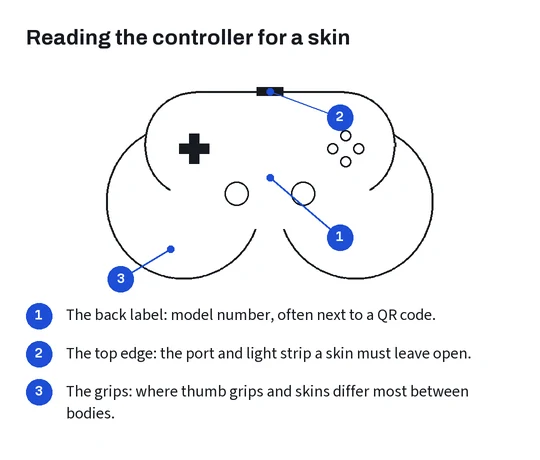
One console maker states that its controller’s model number sits on the back, above the QR code, and that it has eight characters, giving CFI-ZCT1W as the example. That label identifies the controller. It does not tell you which build you have: makers revise controllers during their life, and repair guides list several builds under that one model number, so the label alone cannot show whether a skin was cut for an early or a late one.
For a skin or grip, that means two checks. Match the model on the back with the listing’s option, then compare the option photo with your controller: the port on top, the shape of the light strip, the buttons in the middle. Premium versions with paddles or extra buttons on the back are separate bodies with their own skins. If you fitted a replacement shell or faceplate yourself, check that too: a skin cut for the stock shell may not sit over another.
Handheld console shells and their model numbers
One handheld console family shows the pattern clearly: three bodies, three model numbers, one family name.
The maker’s support page lists the three consoles of one handheld family as HEG-001, HAC-001 and HDH-001, and says where to read each number: on the rear of the console, and for HEG-001 behind the stand, which has to be opened first. When the maker refers to a specific console in its own pages, it adds the model number in brackets.
Shells, grips and screen films follow those bodies, not the family name, and the two larger bodies are close enough in shape to invite a wrong pick. Read the model from the rear, match it to the option, and treat a listing that names only the family as incomplete.
Camera cages and half cases
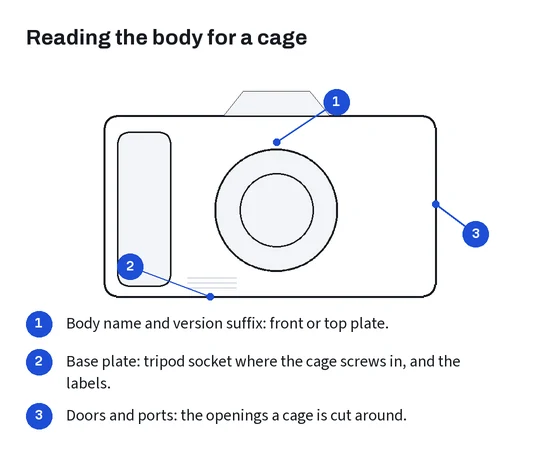
A camera cage is a frame screwed to the body through the tripod socket on the base plate and cut so that the battery door, card slot and ports stay reachable. Cage listings usually name one body, occasionally two closely related ones, because those openings are where bodies differ. Half cases, the leather or silicone kind that wrap the bottom of the body, follow the same logic.
Read the body name on the front or top plate, version suffix included, and check the base plate: one camera maker’s support notes place the serial label on the base plate for its DSLR and mirrorless lines. A battery grip replaces the base plate, so a cage made for the bare body usually will not take a body with a grip attached.
Cage listings often add a list of accessories the cage accepts: handles, top plates, rails. Those fit the cage, not the camera. The line that matters is the body name and version, usually near the start of the title and again in the option name.
Carry cases and padded bags: inside size, not model
Not every add-on in this family is model-bound. A carry case for a controller or a padded camera bag fits by inside dimensions: the controller’s outline, or the camera with its longest lens attached. Those listings give sizes in centimeters, and a little spare room is a feature, not a fault.
That is why the catalog’s bag shelf appears on this site’s wall: it is the counterexample. If an add-on holds the device rather than wrapping it, measure; if it wraps the device, match the model.