
Phone cases, screen protectors and tablet folios chosen by model
A phone case is cut for one body, a screen protector for one pane of glass and one camera hole, a tablet folio for one generation and size. This page takes each in turn.
Phone cases and the camera cut-out
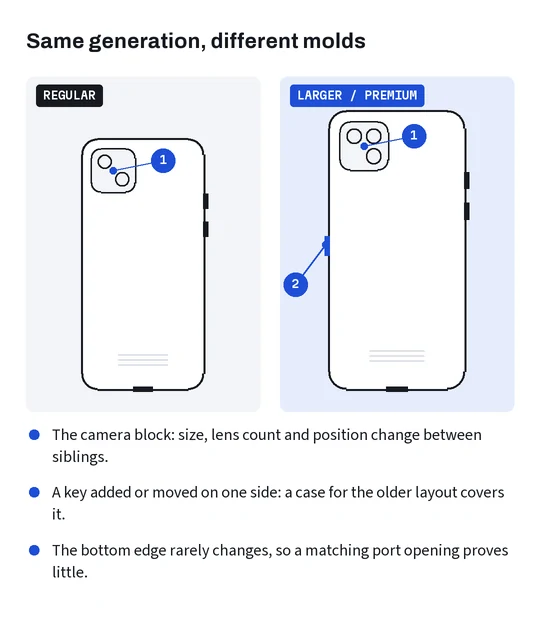
A phone case is molded around one body, and the part of that body that changes most between neighboring models is the camera block. The regular phone of a generation and its larger or premium sibling usually carry blocks of different sizes, with a different number of lenses, sitting in a slightly different place. The cut-out in the case is made for one of them.
Buttons are the second giveaway. One phone maker’s identification page describes, model by model, which side each key sits on, and some of its recent phones carry a camera key on the lower right that other models of the same year lack. A case cut without that opening covers the key with solid plastic. The charging port and speaker grilles along the bottom edge usually stay put, so a matching port opening proves little.
Spec pages help less than you would hope. One phone maker’s hardware page notes that its depth figure leaves out the camera bump and that dimensions vary with configuration and manufacturing, so even the published thickness does not describe the lip a case needs around the lenses. The surest check is still the model name, suffix included, matched against the option name, then the option photo of the back.
Screen protectors, curved edges and in-screen sensors
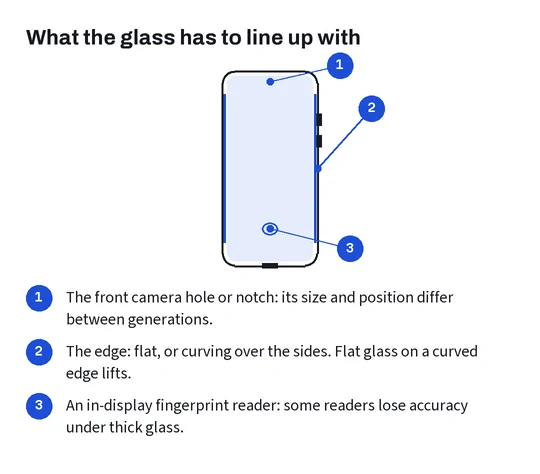
A screen protector has a harder job than a case. It has to match the size of one pane of glass, the hole or notch for the front camera, and the shape of the edge. Some phones are flat; others curve the glass over the long sides, and a flat protector on a curved screen lifts at the edges or leaves a visible halo.
Fingerprint readers under the display add another condition. One Android maker’s support page, dated October 2020, warns that a protective glass cover or thick screen protector may lower the recognition rate on phones with an ultrasonic reader, and recommends its own film. Listings for those phones often split into film and glass options for exactly that reason.
Privacy filters darken the screen when seen from the side. They are sold beside clear glass under the same model run, so they are another option to read carefully rather than a different listing.
Tablet folios and the sizes behind one name
Tablet names are reused across sizes and generations more than phone names are, so a folio listing needs reading twice.
Take one tablet maker’s identification list as an example: a single generation of its premium tablet comes in two screen sizes, and each size has a Wi-Fi model number, a Wi-Fi plus cellular model number and a separate cellular number for China mainland. Six numbers, two bodies. A folio made for the larger size will not close on the smaller one, while the Wi-Fi and cellular versions of one size usually share an outline.
Beyond size and generation, check where the rear camera sits, which edge the front camera is on, and how a stylus attaches: a magnetic strip along one long edge, or none at all. Keyboard covers add a connector strip of their own, and a folio cut for a tablet without that strip can sit over it. The model number on the back cover, or in Settings, is what the identification list is keyed by.
Reading a case listing photo for fit
Listing photos are made to sell color, but they carry fit information if you look at the right frames. The back view shows the camera cut-out and whether the case has a raised lip around it. The side view shows whether the keys are covered with pressable bumps or left open, and whether the extra side key has its own opening.
Some cases have the model name molded or printed on the inside, and many come in a bag or with an insert card that names the model. Neither is visible in a listing, but both can appear in a close-up taken at 100buy’s warehouse if you ask for one; the through-100buy page explains how.
What a photo cannot show is how tight the case will be. Thin cases and thick rugged ones are cut for the same body but hold it differently, which is a matter of taste, not of model.